Pulling a hand-painted envelope out of a stack of bills is one of the small pleasures of the mailbox. Someone took twenty extra minutes so that a piece of mail would feel like a gift. Then, sometimes, that envelope comes back three weeks later under a rubber stamp: Return to Sender.
That is the tension at the heart of mail art. An envelope is a canvas, but it is also a machine-readable document. Sorting equipment has to find the address in a fraction of a second, and a human carrier has to confirm it at a glance. The etiquette of decorated mail is not about toning down your art. It is about giving the postal system what it needs on the front so the art actually arrives.
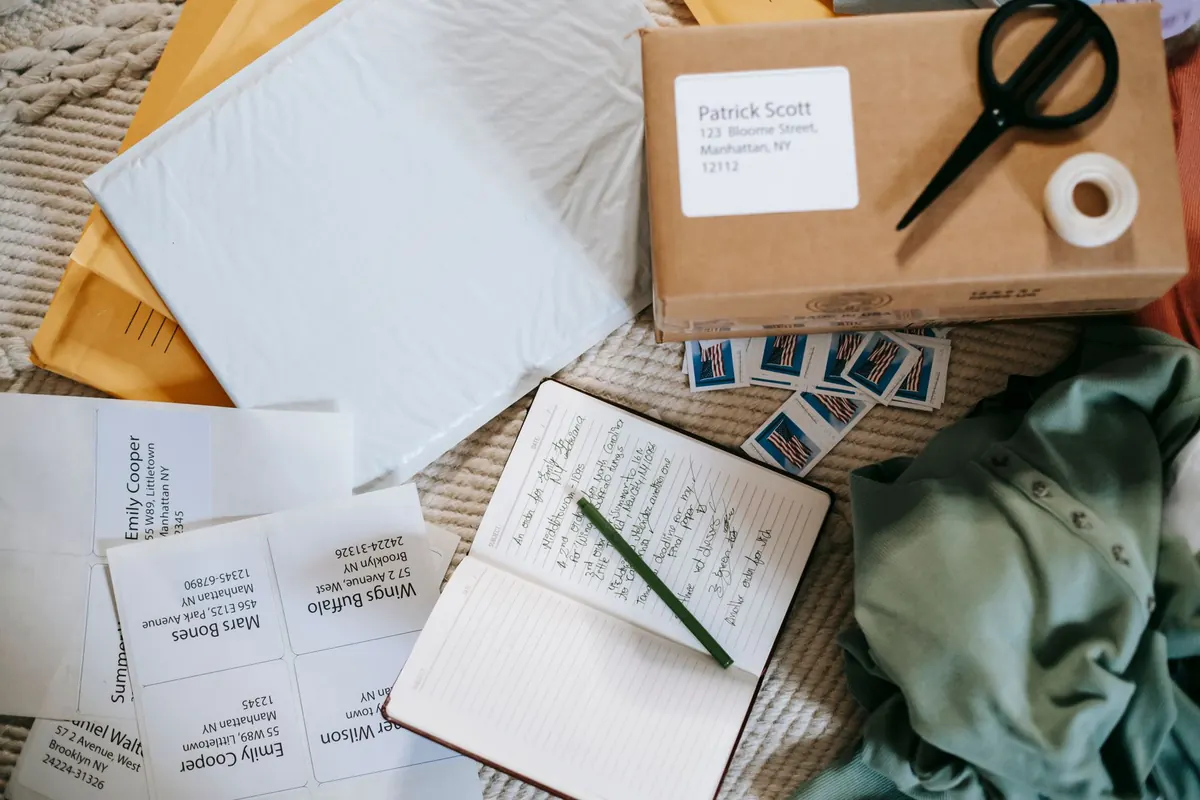
Treat the destination address as functional text and defend it. On a standard envelope in the United States, that means the return address in the upper left, postage in the upper right, and the destination address centered in the lower half of the front. Layouts elsewhere are broadly similar, though many countries expect the return address on the back flap instead of the front.
Write the address in dark, waterproof ink. Print it rather than scrawl it. A seven that could be a one, a two that reads as a Z, a lowercase l sitting next to a one — small ambiguities become misdeliveries, and a beautiful envelope that went to the wrong street is a sad object.
Leave the bottom strip of the envelope relatively clear. On mail that gets sorted by machine, that band is reserved for a barcode, and heavy decoration there can push your envelope into hand-sorting or send it back to you. For international mail, put the destination country alone on the last line, in capitals, in a language the receiving country's postal service will recognize.
The back of the envelope is yours. The flap, the margins, the space around the address block, the entire reverse side — paint, collage, and rubber-stamp them as much as you like. The front is a shared space, and the address, the stamp, and the bottom band are the parts you borrow from the postal service.
A workable order of operations:
One more practical note: stamps need a dry, matte surface to stick. If your design leaves the upper right corner glossy, either mask that area before you start or ask a postal clerk about the best way to attach postage to a slick surface.
Some phrases on an envelope are instructions, not decoration. Written as a joke or a flourish, they can genuinely change how your mail is handled.
A brief note to the carrier can be genuinely useful: "Second floor, rear entrance" or "Please leave with the upstairs neighbor." Keep it to one line, in the same clear block letters as the address, and place it where it will not be confused with the address itself. Carriers are reading in a hurry, in bad weather, with an armload of mail.
Do not write an essay on the front. The outside of an envelope is not a message board, and a paragraph of instructions next to the address is the fastest way to slow your own mail down. If you want a reply, make your return address legible even if it is decorated, and put it somewhere a person can find without turning the envelope over twice.
If you are mailing to a workplace, a shared house, or a care facility, remember that the mailroom sees the outside before the recipient does. A collage that would delight a friend at home can be awkward when it arrives at their office.
In a mail art exchange, keep the arrangements inside the envelope. Whether the recipient should reply, which address to use, how many pieces are coming — those belong on a note tucked in with the artwork, not scrawled on the front where they can read as delivery instructions.
Waterproof ink, acrylic, gouache, permanent marker, rubber stamps with permanent ink, and thin paper collage held down with a good glue stick all survive the journey well. Watercolor and some fountain pen inks can run if the envelope sits in the rain, so use them for the art and something more permanent for the address.
Risky choices include loose glitter — it sheds, and machinery and sorting staff both dislike it — thick wax seals that can crack or catch, buttons, googly eyes, and anything else that makes the envelope lumpy. Washi tape looks lovely and peels at the corners. Pencil smudges. If the finished envelope is not flat and flexible, expect to pay a non-machinable or parcel rate, or expect trouble.
Before you send a masterpiece across an ocean, address one to yourself, decorate it the same way, and drop it in a postbox. It costs one stamp. What comes back tells you whether your paint runs, whether the collage catches in the machine, whether the clerk asks for extra postage, and how the artwork looks after a week of handling.
Then keep one rule in mind for everything you send: if a person sorting mail at four in the morning cannot tell in two seconds where the envelope is going, the design needs another pass. Decorate boldly. Just leave the address alone.
Photo: Liza Summer / Pexels