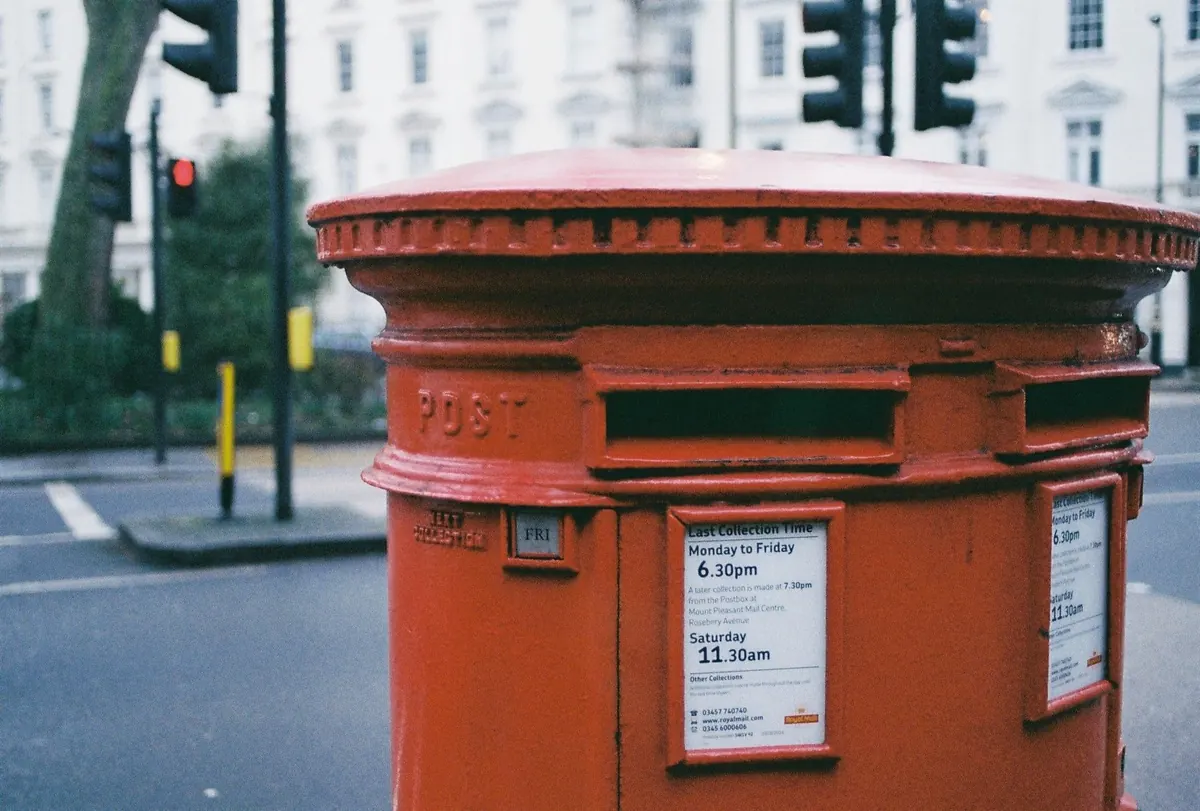
Almost nobody sets out to look at a postbox, and yet almost everyone can picture one: round, red, a slot and a small white plate. That picture is just one of three designs you will pass in an ordinary week. Pillar boxes stand free on the pavement. Wall boxes are set into brick and stone. Lamp boxes are small enough to hang from a bracket or sit on a single post. Learn to tell them apart and a familiar walk becomes something closer to a field survey.
British postboxes are usually grouped by where they were meant to live rather than by how much mail they held.
Rarities exist — hexagonal Penfolds, ornate Ludlow boxes, early "anonymous" boxes with no royal cipher — but they are the exception. Learn the three common shapes and the odd ones stand out immediately.
Pillar boxes arrived in the 1850s, after the Post Office took up a suggestion from Anthony Trollope, then a Post Office official as well as a novelist, that a freestanding box would serve places with no convenient wall. Early examples were tried in the Channel Islands before spreading to the mainland, and they were not instantly elegant. Some were awkward in wet weather, and rain could reach the letters.
That problem shaped the design you still see. The familiar box has a flared cap or dome that throws water clear of the aperture, a hooded slot, a door for emptying, and a plinth that keeps the ironwork off wet ground. A famous early attempt, the hexagonal Penfold design of the 1860s, added a projecting rim for the same reason; a few survive. From the 1870s, red became standard, replacing an earlier green that was hard to spot.
Most surviving variation is decorative: the cipher on the door, the width of the cap, the mouldings at the base. Those details do most of the work when you try to place a box in time.
Wall boxes are the ones people miss. Set flush with a wall, or projecting only a few inches, they can read at a distance as a meter cabinet or a utility hatch. The earliest date from the late 1850s, and the reasoning was practical: where a pillar box would block a pavement, or could not be placed at all — narrow lanes, railway platforms, the wall of an inn or a village shop — a box could be built into the masonry instead.
Look for a rectangular cast-iron face, a slot near the top with a small hood or lip, and a lockable door below carrying the royal cipher and lettering. Many have a second, smaller door for the collection plate. Wall boxes are usually red, though black plinths and black boxes appear. If you find one, study the wall as much as the box: the building often explains why the box was put there.
Lamp boxes take their name from the earliest ones, which hung on lamp posts. A box mounted on a street lamp could serve a quiet road without needing the space, or the mail volume, that justified a pillar box. When street lighting changed, most moved to a wall bracket or a short post of their own.
They are easy to spot once you know the silhouette: roughly the size of a large shoebox, with a shallow hood above the slot, a small door underneath, and little room for anything but a collection plate. Most are cast iron and red, though some are black. Because they are small, they end up in awkward places — the end of a bridge, beside a village hall, tucked into a corner of a car park. That is exactly the point of them.
Resist reading the plate first. Work from the whole box inwards and you will reach a confident identification faster.
One caution on ciphers: in Scotland, boxes bearing the cipher of Elizabeth II prompted a long-running objection, and some Scottish boxes carry a crown instead. Treat the cipher as a rough guide rather than a date stamp.
The three-family scheme is British, but the logic travels. France and Germany use yellow boxes, often on posts or set into walls. The United States uses blue collection boxes in several shapes. Ireland's boxes are green, though many are the same castings as their British counterparts, repainted after independence. Japan's are red and often square-fronted.
Somewhere unfamiliar, ask the same questions: what is the box fixed to, where is the slot, how is it protected from rain, and who empties it? The answers usually explain the design better than any label.
Pick a route you already know — a mile of high street and a few side lanes is plenty — and take a notebook. For each box, note a rough location, which family it belongs to, and one detail that caught your eye: a cipher, a chipped plate, a hood that has been repaired. After three or four walks you will start to see a pattern in where the different boxes are placed, and you will notice replacements and removals that most people walk straight past.
Then keep walking. The next one is usually closer than you think.
Photo: sl wong / Pexels